

How many platforms did your last short-form video actually reach? One? Maybe two? And what type of video was it? Do you know?
Or, be honest: Was your strategy to film something, post it, and move on?
And that’s not wrong. The video exists. It’s short-form. It went up. Nothing broke.
But here’s what didn’t happen: That video didn’t show up where your buyers were researching solutions on YouTube, or scrolling through LinkedIn on a Tuesday morning, or stumbling across competitors on TikTok.
It’s not because the content wasn’t good enough, but because it was only ever given one place to live.
Short-form video distribution isn’t about doing more; it’s about letting what you’ve already built reach more of the people it was made for.
Single-Platform Video Is Leaving Reach on the Table
The assumption behind single-platform posting is that your audience is mostly in one place. The data says otherwise.
84% of U.S. adults use YouTube, yet only 37% use TikTok and just half use Instagram.1 Your buyers are distributed across platforms, each one catching them at a different moment, with a different mindset. Researching. Scrolling. Deciding.
Every video that only lives on one platform is, by default, invisible everywhere else.

The question was never whether to distribute across platforms. It’s understanding what each platform demands once you get there and what kind of content belongs on each one.
Read more: The New Rules of Short-Form Video Strategy
Every Platform Has Its Own Culture and Its Own Definition of Good
Before you copy-paste the same video across channels, it’s worth understanding that each platform doesn’t just have a different algorithm. It has a different culture, a different viewer expectation, and a different reason people open the app in the first place.
Short-form video is already the top ROI-driving content format for 49% of marketers.2 But ROI doesn’t come from volume. It comes from fit.
Read more: Start Your Short-Form Video Strategy Today
LinkedIn: Where Professional Credibility Gets Screen Time
LinkedIn’s audience isn’t there to be entertained. They’re there to learn, to be seen, and to stay sharp in their industry.
Video that performs on LinkedIn earns its place by adding something worth stopping for: a perspective, a lesson, a behind-the-process moment that feels substantive.
Industry POVs, leadership takes, team culture shown through a professional lens—these land. A trending audio clip doesn’t.
Pro Tip: Most LinkedIn users watch without sound, so captions aren’t optional, and CTAs should point toward a conversation or a resource rather than a follow.
TikTok and Instagram Reels: Where Personality Is the Strategy
Forget polish. These platforms reward authenticity and the ability to stop a scroll in the first two seconds. That doesn’t mean abandoning professionalism. It means finding the human side of the work and leading with it.
POV content, day-in-the-life clips, founder personality, cultural moments tied to your industry—these translate well because they feel real.
Trending audio can extend reach even for B2B content, but only when it’s used with genuine relevance. Audiences here are quick to spot the difference between a brand that gets the culture and one that’s just borrowing it.
YouTube Shorts: Where Search Does the Work for You
Unlike every other short-form platform, YouTube Shorts often catches people mid-research. They typed something in, and your video surfaced. That changes the entire content calculus.
Educational clips, how-to micro-content, quick-take answers to industry questions; these perform because they’re built around intent, not entertainment.
Pro Tips: Titles matter more on YouTube than anywhere else in short-form, so write for search first and scroll second. Trend-dependent content has a short shelf life here. Evergreen wins, and it keeps winning long after the post date.
How to Know If Your Distribution Is Actually Working
More platforms mean more data and more opportunities to confuse activity with performance. The goal isn’t to track everything but to know which signals actually mean something on each channel. The same number can tell a completely different story depending on where it comes from.
Read more: When Short-Form Content Delivers More Impact Than Long Copy
A view on YouTube Shorts is not the same as a view on TikTok, and neither is the same as an impression on LinkedIn. The definitions differ, and so does what they indicate about buyer intent. Before optimizing for numbers, make sure you’re reading the right ones.
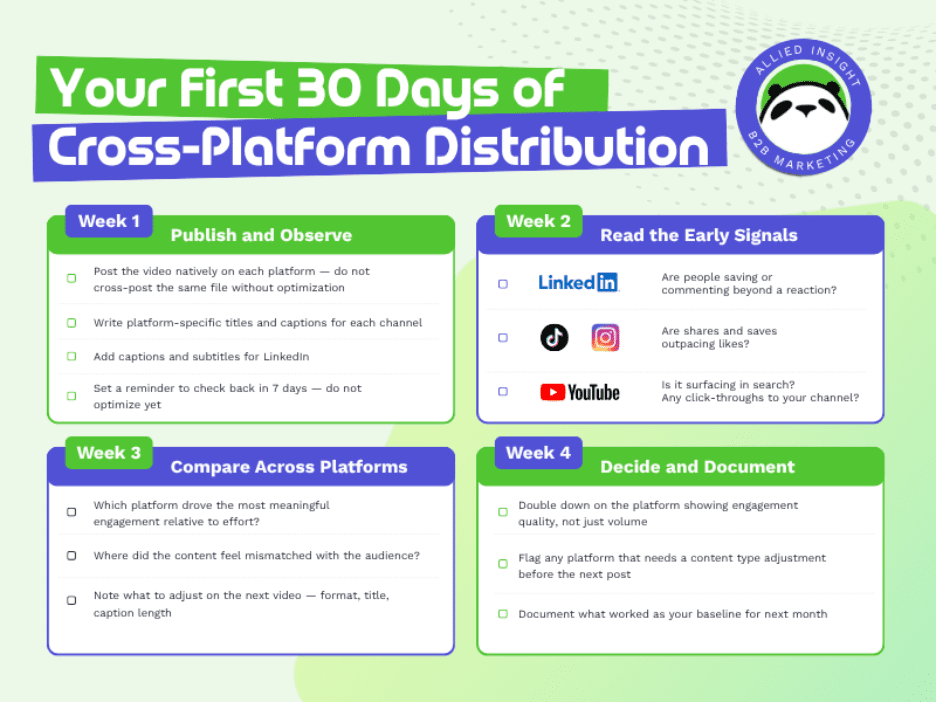
One video tells you almost nothing. However, a month of cross-platform data starts to reveal where your audience actually lives versus where you assumed they did. Before optimizing—or worse, abandoning a platform entirely—give the distribution strategy enough runway to show a pattern. When it’s time to adjust, let engagement quality drive the decision, not just volume.
Stop letting great videos live on one platform.
Short-form video’s value isn’t determined at the record button but at the distribution decision. The brands seeing the strongest return from video ensure the content they create reaches audiences on every platform, where those audiences actually are.
Allied Insight helps marketing leaders build content strategies that extend reach across platforms—turning one idea into multi-platform assets that keep working. Let’s build your distribution strategy.
References
1. Gottfried, Jeffrey, and Eugenie Park. “Americans’ Social Media Use 2025.” Pew Research Center, 20 Nov. 2025, www.pewresearch.org/internet/2025/11/20/americans-social-media-use-2025/.
2. “Marketing Statistics Every Team Needs to Grow in 2026.” HubSpot, 2025, www.hubspot.com/marketing-statistics.


