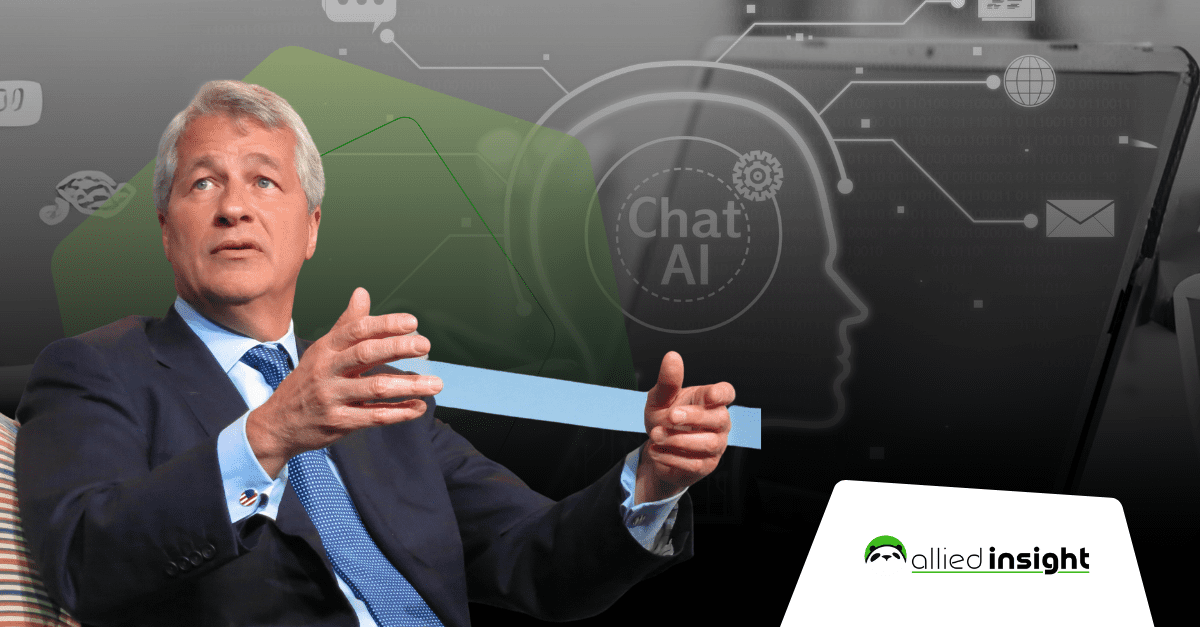
Imagine walking into your local bank branch, sitting down with an AI-powered financial advisor, and saying, “I’ve got 30 years. What should I do?” According to JPMorgan Chase CEO Jamie Dimon, this scenario isn’t just possible – it’s already happening to some extent. Dimon has been making waves in his bold predictions about AI’s role in the future of finance.
And he’s not just talking about fancy chatbots or automated customer service. He envisions AI will “augment virtually every job” in the banking sector and beyond. But what does this AI-augmented future really look like for workers, especially in industries like staffing?
Will AI be our new co-pilot and help us make smarter decisions and work more efficiently? Or should we be worried about robots taking our jobs? This is what we’ll dive into!

AI Augmented Applications in Industries
Unlike robots, which are physical machines that carry out tasks, AI is the software that enables them to think and learn. Here’s how AI is augmenting jobs in various industries.
Finance
In Dimon’s banking world, JP Morgan Chase is using AI to enhance fraud detection, automate loan approvals, and even provide personalized financial advice. Imagine an AI system that can analyze a client’s entire financial history, market trends, and risk tolerance to offer tailored investment strategies. It’s not replacing financial advisors; it’s empowering them with data-driven insights to serve clients better.
Healthcare
In diagnostics, Enlitic uses AI-powered image recognition driven by deep learning algorithms to help radiologists spot potential issues in X-rays or MRIs with greater accuracy. In drug discovery, Insilico Medicine leverages AI algorithms to sift through vast databases of molecular structures to identify promising new compounds, dramatically speeding up the research process.
Rather than replacing healthcare professionals, AI tools like these enhance decision-making, leading to better patient outcomes.
Manufacturing
The factory floor is getting smarter with AI. Predictive maintenance algorithms utilizing machine learning can forecast machine failures, allowing for proactive repairs and minimizing costly downtime.
Companies like Siemens utilize AI to optimize production lines, enhancing efficiency and reducing operational costs. AI-powered quality control systems can spot defects faster and more accurately than the human eye, as seen in Honeywell’s manufacturing processes. This doesn’t mean fewer jobs; it means workers can focus on handling complex tasks while AI handles the repetitive ones.
Staffing
AI development has transformed traditional Applicant Tracking Systems (ATS) from basic resume parsers into powerful tools for automating candidate sourcing across multiple channels. It enhances the candidate experience with personalized communication and reduces bias in evaluations by applying objective criteria.
Predictive analytics also help forecast a candidate’s success, leading to better hiring decisions. In fact, according to McKinsey, companies leveraging AI in their hiring processes can reduce time-to-hire by up to 50 percent and improve the quality of hires by 30 percent.¹ This highlights AI’s significant role in elevating staffing practices to meet the demands of a dynamic job market.
Read More: Is Your Tech Stack Drowning You? Here’s How to Stay Afloat
Benefits and Challenges of an AI-Augmented Future
As generative AI continues to evolve, it offers numerous benefits and challenges for the workforce. Understanding these dynamics is crucial for preparing for an AI-augmented future.
Benefits
Here’s how AI benefits your agency.
- Increased Productivity and Efficiency: Handles the grunt work – think resume screening and scheduling – so your team can concentrate on what really matters: building relationships. More time connecting with candidates and clients means happier customers and higher quality placements.
- Enhanced Decision-Making: AI utilizes data analytics to spot trends, identiy top talent, and predict market shifts. This means you can make faster, smarter hiring decisions and deliver better results to your clients.
- Innovation and Growth: AI is fueling innovation across industries. In staffing, it’s revolutionizing how we find, attract, and place talent. With AI, you can adapt quicker to market changes, discover new talent pools, and create growth opportunities you never thought possible.
Challenges
Despite its benefits, AI presents challenges.
- Skills Gaps: AI is raising the bar for skills. Your team needs to keep up with the latest tech or risk getting left behind. It’s a tightrope walk between using AI and being controlled by it.
- Ethical and Bias Concerns: AI can be biased if not handled right. Unfair hiring practices can damage your reputation. Protecting candidate data is crucial to building trust.
- Integration Challenges: Combining AI with your existing systems can be tricky and expensive. You don’t want to disrupt your workflow, but you also can’t afford to miss out on the benefits.
Read More: 3 Little-Known AI Technology Dangers That Could Be Hurting Your Recruitment Process
Thriving in the AI-Augmented Age
The future of staffing is AI-driven, and your team needs to be equipped for the journey.
Here are the key skills you and your team need to stay ahead.
Technical Proficiency
Get comfortable with AI tools like Teamable for sourcing, Paradox for chatbots, or HireVue for video interviews. Understand how they work and what they can do for you. It’s not about becoming a programmer; it’s about knowing how to leverage these tools effectively.
Data Literacy
Numbers tell stories so learn to read them. Master the basics of data visualization tools like Tableau or Power BI. Look for trends, outliers, and correlations in your recruitment metrics. Interpret AI-generated insights and use them to make smarter decisions. This skill will set you apart in client meetings and strategy sessions.
Adaptability
The only constant is change, right? Embrace it. Stay curious, be open to new ideas, and always be ready to pivot. This mindset will keep you and your team agile in an ever-evolving landscape.
Critical Thinking and Creativity
AI provides the data, but you provide the wisdom. Sharpen your ability to analyze information, question assumptions, and make sound judgments. This skill is crucial when navigating ethical considerations in AI-assisted recruiting. Use AI insights as a springboard for innovative solutions. Your creative problem-solving skills will be invaluable in scenarios where AI hits its limits.
Continuous Learning
Make learning your hobby. Stay updated on AI trends in staffing. Attend workshops, read industry reports, and share knowledge with your team. This commitment to growth will keep your agency at the cutting edge.
The Future of Work: Embracing the Human Touch
Jamie Dimon’s prediction of AI augmenting every job is a reality taking shape. In the staffing industry, AI is evolving from a novelty to a necessity. But remember, it’s a tool, not a replacement.
Your unique ability to understand people, build relationships, and solve complex problems is irreplaceable. Combine this human expertise with AI’s data-driven insights, and you have a recipe for success. The future of staffing lies in this harmonious partnership.
The future of staffing is all about this human-AI collaboration. Embrace AI, upskill your team, and you’ll be ahead of the game.
Read More: How AI Drives Human Resources Into the Future
PARTNER WITH ALLIED INSIGHT FOR A SMOOTH TRANSITION TO THE AI-POWERED FUTURE!
As a niche marketing agency specializing in the staffing industry, Allied Insight assists staffing agencies in developing targeted strategies to attract and retain top talent in a competitive employment market. Our experts have deep industry knowledge and a data-driven approach to boost your staffing agency’s success in the AI-powered future of work.
Contact us today to create a successful human-AI partnership that drives your business forward.
Reference
- Why there will be plenty of jobs in the future — even with artificial intelligence (2024, February 26). World Economic Forum, https://www.weforum.org/agenda/2024/02/artificial-intelligence-ai-jobs-future/