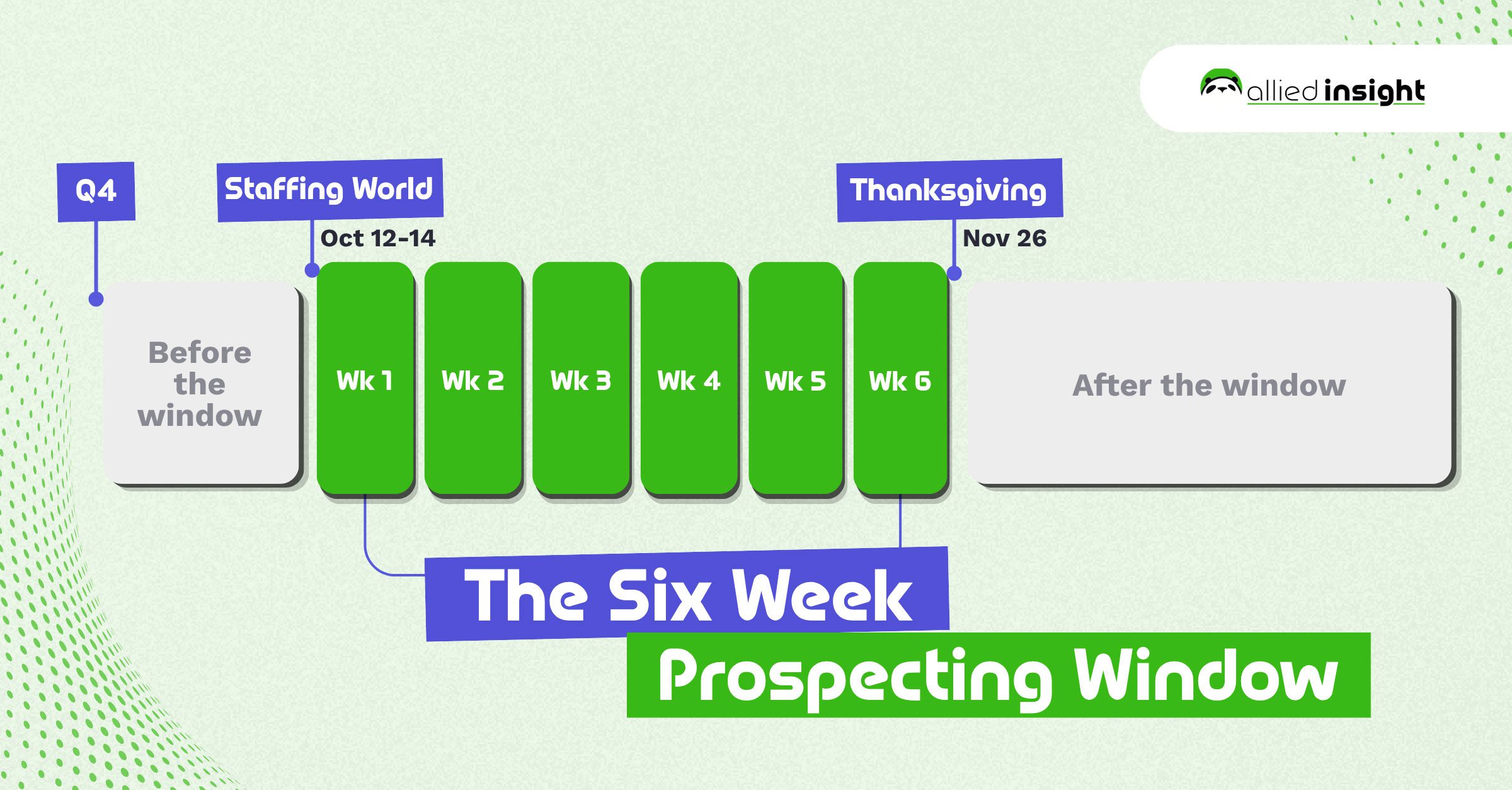
The direct answer: Q4 runs thirteen weeks and about six of them are usable. The October conference reset opens the window, next-year budget decisions close it around Thanksgiving, and work published after that arrives at a decision already made. Three things fit inside six weeks: pick the buying question, put one usable asset in market, and follow it with a specific offer.
Scope: this piece maps the six working weeks inside Q4, not a general case for urgency, and closes with three numbers that show whether the window is being used.
Most firms treat the fourth quarter as one long runway. It behaves like a short one. The American Staffing Association’s own data bears this out: Q4 is historically the sector’s peak quarter, and even in a down year the shape holds. Q4 2025 average weekly staffing employment climbed to roughly 2 million workers, up 65,000 from Q3. Year-over-year sales came in at $29.9 billion, a 6.2% decline that was itself an improvement on the 8.5% drop the industry was running earlier in the year.1 The quarter is shaped a specific way for a buyer: the industry calendar takes most of October, budget conversations for next year start immediately after, and by the last week of November the money for the first half is broadly spoken for. The distance between those two edges is about six weeks, the only part of the quarter where a new name can still enter a plan.
That changes what Q4 marketing is for. It is not a push, and it is not a fourth attempt at the same outreach. It is the last chance to be present while a buyer is deciding what next year looks like, which means the asset has to be in market before the conversation, not during it. This guide covers why the window is shorter than the calendar suggests, what has to already be live before it opens, a week-by-week map of what ships, how to read a buyer’s silence inside that window, and three numbers that show whether it worked. The proprietary layer underneath it is Allied Insight’s own editorial record of how conference-tied and forecast-tied pieces get timed against each other.
This opens with the calendar because every other Q4 decision inherits it: what to publish, what to hold, and what to stop paying for. The map below is built from dates, not from a theory about urgency.
Why does Q4 feel like a long quarter and behave like a short one?
A calendar quarter and a buying quarter are not the same length, and the gap between them is where most Q4 plans lose weeks without anyone deciding to spend them. Thirteen weeks on a calendar. Roughly six that a buyer is actually available to be moved, which is the number the rest of this guide works from.
The compression comes from both ends at once. Staffing World runs October 12 through 14 in Denver, and it absorbs most firms’ attention through the third week of the month while the industry compares notes and resets its priorities.2 Two more anchor events land November 9 through 11: the SIA Healthcare Staffing Summit and the TechServe Executive Summit, running in parallel.3 By the time those wrap, there are roughly two weeks of open calendar left before Thanksgiving, and internal planning for next year’s budget is already underway inside most buyer organizations by then. After Thanksgiving, the decisions that matter for the following year are largely made, whether or not the paperwork is signed.
There is a scheduling pattern behind this that is easy to get backward. A piece meant to be used right now belongs inside the season it serves. A piece telling the reader what is coming needs to land a month or more ahead of it, because the reader has to have time to act on the forecast before the window it describes opens.4 Applied to Q4, that means the asset a buyer needs while they are deciding next year’s marketing spend has to already be live before the deciding starts, not published alongside the announcement of a new program. Firms that wait for a natural pause in the calendar to publish are, without realizing it, publishing on the wrong side of that rule almost every year, and building the calendar around the buyer’s cycle rather than the writer’s, the approach behind our process, is the fix.
None of this is a claim about urgency. It is a claim about arithmetic: two conference weeks, roughly two weeks of planning overlap, and a hard stop at the holiday. That leaves six.
What has to be in market before the window opens?
Before Staffing World opens on October 12, three things need to already exist: a clear point of view on what the quarter’s buying question is, one asset built to answer it, and an offer specific enough that a reader can say yes or no to it without a call.
The point of view is the cheapest of the three and the one most often skipped. It needs no new research, only a clear stance, stated before the conference floor starts repeating the same three ideas back to itself, so a reader encountering it in the two weeks after the event recognizes it as a position rather than a recap. A quick scan of our resource library is usually enough to confirm whether that stance already exists somewhere and just needs restating.
The asset is where the six-week rule bites hardest. Under the timing pattern above, a piece meant for use during the window should already be published, not scheduled for the week the window opens. A firm that plans to write its Q4 asset the week of Staffing World has already spent one of its six weeks on production instead of distribution, which is exactly the gap a standing content program closes.
The offer is the piece most plans leave vague. “Let’s talk” is not specific enough to act on inside a six-week window. A reader deciding what next year looks like needs to know exactly what saying yes gets them: a defined, time-bound engagement, not an open invitation to a conversation. Vagueness here turns a six-week window into a two-week one, because the first two or three weeks get spent clarifying what was actually being offered.
Open your Q4 calendar and count the working days between your last event and the week budgets lock. Under thirty, the next asset is already late and those meetings land in January. Not sure what ships first? Compare notes with us
The Six-Week Map: What Goes Out, and When
Laid against the actual dates, the window breaks into six blocks, each with one job. Nothing here depends on a firm’s size or specialty; it depends only on the two conference dates and the Thanksgiving cutoff, fixed for every firm reading this in the same calendar year.
| Week | Dates (2026) | What goes out |
| 1 | Oct 12–18 | Conference-tied point of view, published during or immediately after Staffing World |
| 2 | Oct 19–25 | The core asset, already built and simply released, not started |
| 3 | Oct 26–Nov 1 | The specific offer, attached directly to the asset’s distribution |
| 4 | Nov 2–8 | Second-wave distribution: direct outreach, LinkedIn amplification, follow-up to early responders |
| 5 | Nov 9–15 | Second point of view, tied to the SIA Healthcare Staffing Summit and TechServe Executive Summit |
| 6 | Nov 16–22 | Final push before the holiday; last calls booked land as January meetings, not December ones |
After week 6, the week of Thanksgiving and the two weeks that follow are not dead, but they are no longer a prospecting window; they are a scheduling window for meetings that were already earned in weeks 1 through 6. Anything not already in motion by week 6 is, in practice, aimed at Q1, and worth planning for as Q1 work rather than treating as a late Q4 save.
How do you tell an early no from a not yet?
Inside a six-week window, the costliest mistake is treating every non-response the same way. Some of what looks like silence is a firm still deciding. Some of it is a decision already made without you, and telling the two apart is what keeps a firm from wasting its remaining weeks on a door that’s already closed.
An early no tends to look like this: a specific, dated objection tied to something already locked, a named budget line already spoken for, a vendor already selected, a program already scoped for next year. It is unpleasant to hear in October, but it is useful, because it frees the remaining weeks for a prospect who has not yet decided, a distinction our own account team makes weekly during this stretch.
A not yet tends to look different: a vague deferral with no date attached, interest in the content itself without a next step, or a reply that engages with the point of view but not with the offer. That is not a rejection of the offer; it is often a signal that the offer arrived before the reader had a decision to attach it to, which is common in weeks 1 and 2 and far less common by week 4.
The practical test is whether the objection names something specific that has already happened. If it does, treat it as an early no and move on inside the window rather than continuing to work it. If it doesn’t, the reader is very likely still inside their own version of the six weeks, just on a slightly different clock.
Three Numbers That Say the Window Is Working
Three measures, tracked weekly across the six-week map rather than totaled once at quarter’s end, say more about whether the window is being used than a single end-of-quarter tally ever will, because a weekly view catches a timing problem while there is still a week left to correct it.
1. Meetings booked, by week. A window that is working shows bookings concentrated in weeks 2 through 5, not weeks 1 or 6. If bookings are flat across all six weeks, or clustered only at the end, the asset likely went out too late to do its job before the planning window closed.
2. Time from asset to first reply. A short gap between when the asset reaches a reader and when they respond, whether with interest or an early no, indicates the reader already had the buying question in mind. A long gap, or silence that only resolves after a second or third touch, suggests the point of view didn’t land before the reader’s own planning did.
3. Ratio of early no to unexplained silence. Counterintuitively, a rising share of early nos relative to total non-responses is a good sign this deep into the window: it means the firm is reaching people who are actually deciding, even when the decision goes elsewhere. A high and rising share of unexplained silence, by contrast, usually means the offer isn’t specific enough to prompt any answer at all.
Diagnostic logic: if bookings cluster late and time-to-reply is long, the asset shipped after the reader had already decided; pull the whole sequence forward next year. If early nos are rising but bookings aren’t following, the point of view is landing but the offer isn’t, so sharpen what saying yes actually gets someone. If unexplained silence is high and rising, the problem is upstream of the offer entirely: the point of view isn’t specific enough to prompt a reaction either way.
Most Q4 plans still assume thirteen usable weeks. Count backward from Thanksgiving instead of forward from October, and the six real weeks show up on their own. Want a second pair of eyes on what ships first? Talk it through with us
Frequently Asked Questions
How long is Q4 for B2B prospecting, really?
Should I still be sending outreach after Thanksgiving?
Outreach sent after the holiday is far more likely to land against a decision that has already been made than to influence one. It is not wasted, but it should be aimed at January meetings, not December ones.
What’s the difference between a Q4 push and a Q4 asset?
A push is more volume of the same outreach. An asset is a single piece of work, published before the window opens, built to answer the specific question a buyer is asking themselves while they plan next year’s budget; it’s the difference our approach is built around.
Do I need new content for Q4, or can I reuse something?
Either can work, but the choice should be deliberate. A point of view can be restated; the specific offer attached to it cannot be vague and still function inside a six-week window, which is the judgment call our team helps firms make each fall.
What if my industry’s event calendar doesn’t line up with October?
The six-week logic isn’t specific to Staffing World. Any industry with a fall conference season and a calendar-year budget cycle has the same two edges: find your own conference reset and your own budget-lock date, and the window between them is very likely a similar length.
The Window Doesn’t Care How Busy You Were
Six weeks, not thirteen. That is the entire argument, and the numbers behind it are unglamorous: two conference weeks that absorb attention, a holiday that locks budgets, and the arithmetic in between. A firm that treats all of Q4 as open runway will spend real effort inside a window that, for the reader on the other end, closed weeks earlier.
The firms that use the window well are not doing more. They are doing the same three things in the right order and on time: a point of view live before the conference floor repeats it back, one asset built and released rather than started late, and an offer specific enough to get a real answer, yes or no, inside six weeks. Getting the order right is a scheduling decision, not a creative one, which is why our programs exist to diagnose it from the outside. If the honest answer is “we haven’t mapped our own six weeks yet,” that’s worth a closer look before the window closes again, and our blog covers the rest of the quarter’s planning questions in more depth.
References
- American Staffing Association, “Employment and Sales Rebound in Q4,” published March 30, 2026. americanstaffing.net/posts/2026/03/30/employment-and-sales-rebound-in-q4
- Allied Insight’s internal record of verified industry conference scheduling and its own editorial content-timing practice, compiled from internal planning records.